
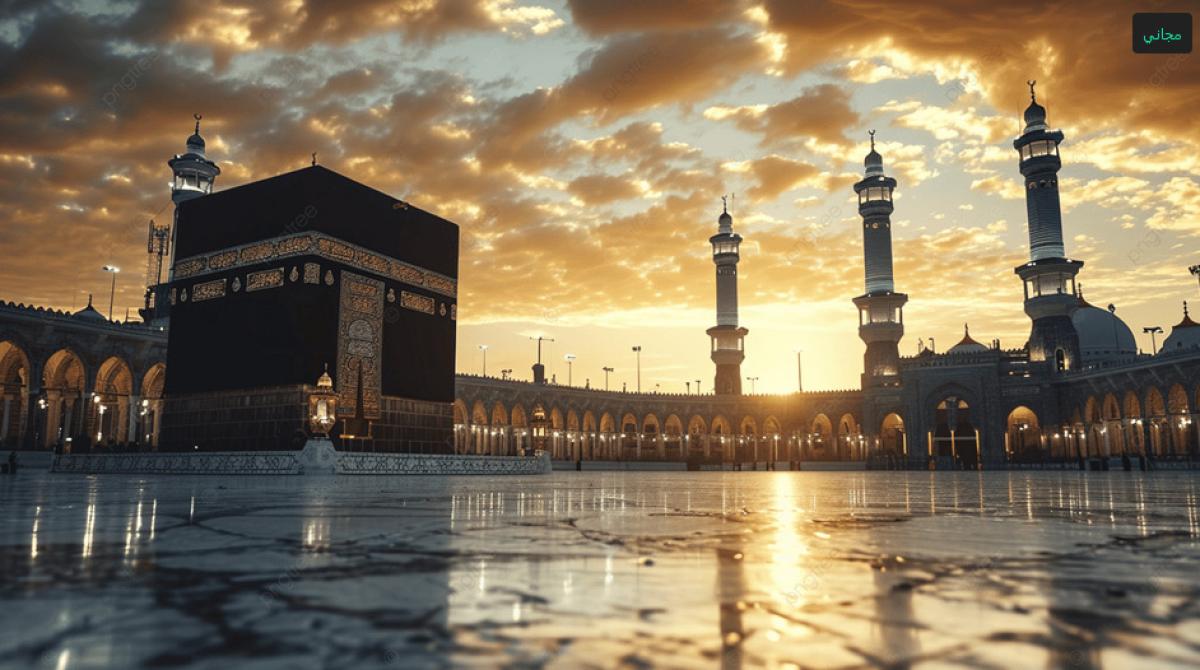
The greatest mosque in Islam and the heart of Mecca, its vibrant soul! The Sacred Mosque, also known as Al-Haram Al-Makki.
What do you know about Al-Haram Al-Makki? Here we present the most important information about Al-Haram Al-Makki.
Location of Al-Haram Al-Makki
Al-Haram Al-Makki is located in the center of the city of Mecca, in the holiest place on earth. The Sacred Mosque is considered the first house established for people to worship Allah, as mentioned in the Holy Quran: {Indeed, the first house established for mankind was that at Bakkah, blessed and a guidance for the worlds} (Al-Imran: 96).
Al-Haram Al-Makki extends over a large area that includes many important Islamic landmarks, such as the Kaaba, the Station of Ibrahim, and the Well of Zamzam… etc.
Reason for its Name Al-Haram Al-Makki
The Sacred Mosque in Mecca is named as such because Allah has made it sacred until the Day of Judgment; fighting is not permitted there, its game is not to be disturbed, its trees are not to be cut down, and its grass is not to be uprooted. Abdullah ibn Abbas reported: "The Messenger of Allah ﷺ said on the day of the Conquest of Mecca: There is no migration, but there is jihad and intention, and if you are called to arms, then respond. And he said on the day of the Conquest of Mecca: This city has been made sacred by Allah on the day He created the heavens and the earth, and it is sacred by the sanctity of Allah until the Day of Judgment. Fighting has not been permitted in it for anyone before me, nor has it been permitted for me except for a short time during the day. It is sacred by the sanctity of Allah until the Day of Judgment; its thorns are not to be pruned, its game is not to be disturbed, and only those who recognize it may pick up anything that is lost, and its grass is not to be uprooted." The pilgrimage to the Sacred House of Allah is one of the five pillars of Islam, and it is obligatory for every able Muslim to perform it once in their lifetime. Allah says: {And pilgrimage to the House is a duty to Allah for mankind, for whoever is able to make the journey to it} (Al-Imran: 97). A single prayer in the Sacred Mosque is equivalent to one hundred thousand prayers in any other mosque. The Prophet ﷺ said: "A prayer in this mosque of mine is better than a thousand prayers elsewhere, except for the Sacred Mosque."
History of Al-Haram Al-Makki
1. Construction of the Kaaba
The Kaaba is located in the center of the Sacred Mosque, and it is a cubic structure resembling a square, approximately 15 meters high. The Kaaba was built by the command of Allah -the Exalted- by His friend Ibrahim and his son Ismail -peace be upon them- as mentioned in the Holy Quran: {And when Ibrahim raised the foundations of the House and Ismail} (Al-Baqarah: 127).
The Kaaba is the qibla for all Muslims around the world, and they face it in their prayers.
2. Expansions Throughout History
The Sacred Mosque has witnessed many expansions throughout the ages. The first expansion occurred during the caliphate of Umar ibn Al-Khattab -may Allah be pleased with him- when he noticed the need for a larger space to accommodate pilgrims and worshippers. He purchased the houses surrounding the Kaaba and expanded the area of Tawaf, as well as adding new doors.
During the caliphate of Uthman ibn Affan -may Allah be pleased with him-, another phase of expansion took place. The caliph Uthman purchased more houses surrounding the Kaaba and expanded the mosque, as well as building covered porticoes for the mosque, being the first to implement porticoes in the Sacred Mosque.
Expansions continued during the Umayyad and Abbasid caliphates, where the Umayyad and Abbasid caliphs increased the area of the mosque and added marble columns and beautiful decorations. During the Abbasid era, the expansion of the Sacred Mosque reached its peak during the caliphate of Al-Mahdi, where its area significantly increased to accommodate the growing number of pilgrims.
As for the Saudi era, the Sacred Mosque has witnessed massive expansions in the modern Saudi era, starting with King Abdulaziz Al Saud's first major expansions, which continued under subsequent kings.
These expansions brought about radical changes in the structure of the mosque, with new floors, covered porticoes, and modern facilities to serve pilgrims and worshippers.